
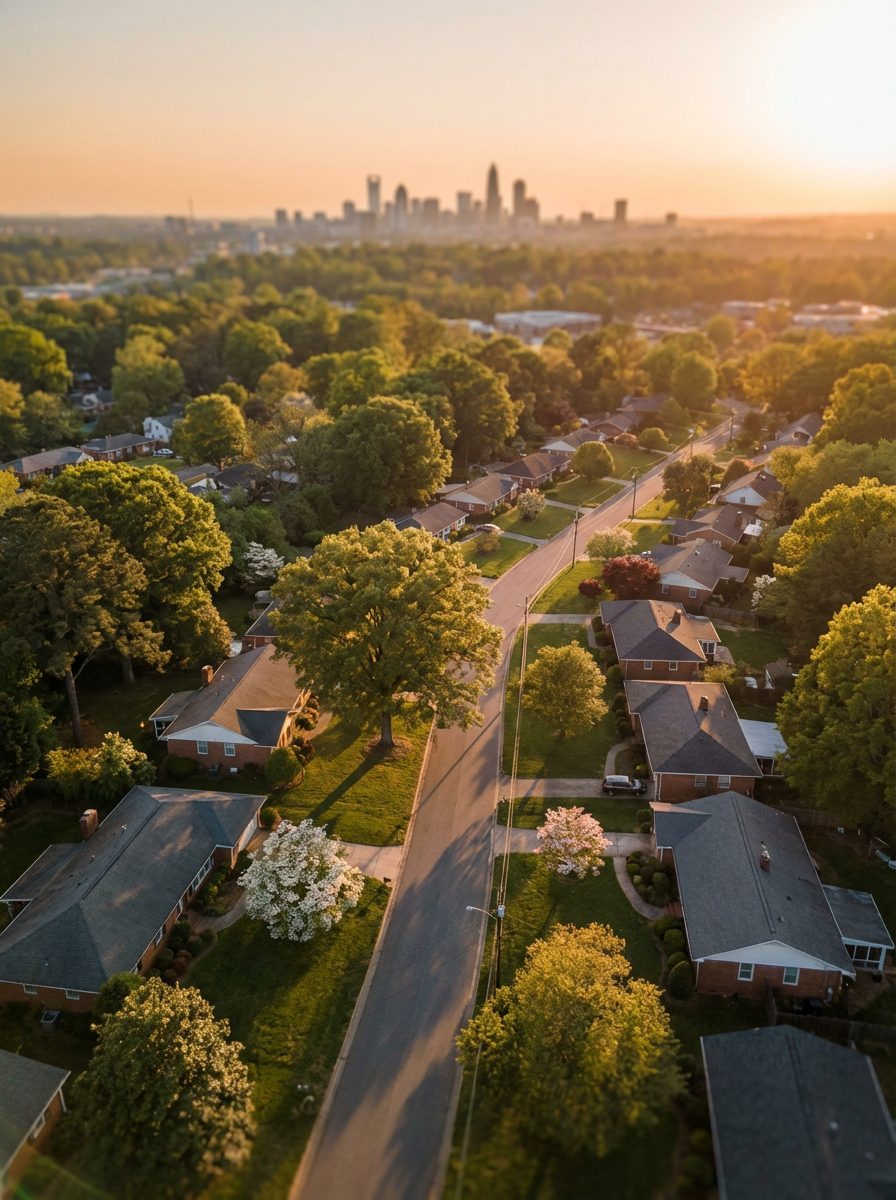
Every "Charlotte housing market prediction" you've read was written by someone selling listings or clicks. I buy houses in this market with my own money — 250+ North Carolina purchases and renovations since 2021, and 40 rentals I still own. When I'm wrong about where Charlotte is heading, I lose real dollars. That changes how carefully you forecast.
So here's the 2026 read the way I give it to my own team, plus the decision framework I'd use if it were my house.
Ryan Smith, Founder, Cinch Home Buyers — real estate investor, not an agent. My market commentary has been cited by Realtor.com, U.S. News (on why some homes sell faster than others), Morning Brew, and Yahoo Finance.
The Short Version
- Charlotte is not crashing, and it is not 2021 again. It's a normalizing market: more inventory than the frenzy years, longer days-on-market, buyers with leverage they haven't had in half a decade.
- Retail-ready houses still sell. If your home is updated and you can wait out a normal marketing period, list it. You'll likely gross more than any cash buyer will pay — including me. I say that on every page of this site.
- Dated and distressed houses are where the market has actually turned. Financed buyers have choices now, and they're choosing the renovated house down the street. That's the segment where "wait" is quietly expensive.
What I Watch Instead of Headlines
1. The Mecklenburg distress trendline
We maintain the NC Distressed Property Index — 16,180 distressed properties tracked across 23 North Carolina counties, updated from county-level records, free for anyone to cite (CC-BY). Mecklenburg County is one of the counties we track: pre-foreclosures, tax delinquencies, code enforcement cases, estates.
Why it matters for your sell-or-wait call: distressed properties are your true competition if your house needs work. Every pre-foreclosure and estate sale that hits the market as-is competes directly with your dated ranch for the same investors and the same small pool of renovation-tolerant buyers. When county distress volume rises, as-is sellers who wait are waiting into more competition, not less. Check the Mecklenburg section of the index before you decide — it's the one dataset on this question nobody else in Charlotte publishes.
2. What buyers can actually finance
Rates set the ceiling on what a financed buyer can pay, and financed buyers set retail prices. But there's a second-order effect nobody talks about: at higher rates, buyers get pickier. A monthly payment at the edge of qualification leaves no room for a $30K renovation loan on top. That's why the price gap between "done" houses and "needs work" houses in Charlotte has widened — the buyer for the second house increasingly has to be cash.
3. What cash offers are actually running against ARV
Here's the number realtor blogs can't give you, because they don't write offers. A professional cash offer is built like this:
Offer = After-Repair Value − renovation cost − holding/transaction costs − the buyer's margin
A real, closed example from our own book (Archdale, NC — Triad, same math applies in Charlotte): we bought a pre-foreclosure home for $114,000 days before the owner would have been locked out. Renovation ran roughly $35,000 against an after-repair value of $225,000. Purchase price was about 51% of ARV; with the rehab, our all-in was roughly 66% of ARV before holding and closing costs. The seller walked away with equity instead of an eviction and a foreclosure on their record.
That's the honest shape of cash pricing: on heavy-repair houses, expect offers meaningfully below retail — because someone has to fund and carry the renovation. On lighter-repair houses the percentage rises. Any cash buyer who won't show you their math the way I just did is hoping you won't ask.
Sell Now or Wait: The Actual Framework
| Your situation | 2026 answer | Why |
|---|---|---|
| Updated house, no deadline | List it, or wait comfortably | Retail buyers still pay up for finished homes. Time is on your side. |
| Dated house, no deadline, cash to renovate | Renovate then list — or wait | You capture the renovation spread yourself. This is literally my business model; you can run it once on your own house. |
| Dated house, no cash for repairs, no urgency | Lean sell | The done-vs-dated price gap is widening, and distress inventory competes with you. Waiting rarely improves the as-is price. |
| Payments you can't sustain, pre-foreclosure, estate, divorce, tired-landlord | Sell now | Carrying costs plus foreclosure risk compound monthly. In NC, even after a foreclosure auction there's a 10-day upset bid period — but the time to act is before the courthouse steps, not after. |
The pattern: "wait" is a luxury good. It pays for owners of finished houses and costs owners of unfinished ones. Most 2026 forecasts miss this because they talk about "the Charlotte market" as one market. It's two.
What Waiting Actually Costs (Run Your Own Numbers)
Say your as-is house would net you $X today. Waiting a year costs you, at minimum:
- 12 months of mortgage interest, taxes, insurance, and upkeep on a house you've mentally left
- Continued aging of the systems that already scare retail buyers — pre-Feb-1978 lead paint disclosures, 1965-73 aluminum branch wiring, polybutylene plumbing (1978 to mid-1995), galvanized supply lines past their 40-50-year life
- The risk that Mecklenburg distress inventory — your direct competition — grows while you wait
Against that, the upside case has to be strong appreciation in the as-is segment specifically. I'm not underwriting deals on that assumption in 2026, and I wouldn't build your family's plan on it either.
If You Decide to Sell
Two clean paths:
- Retail-ready? Interview agents, price to the first 30 days, and read our guide to seller closing costs in NC so the net doesn't surprise you — North Carolina is an attorney-closing state, and the excise tax, attorney fee, and payoff all come off the top.
- Needs work, or you need certainty and a date? Get a written cash offer and compare it against your realistic net after repairs, commissions, and months of carrying costs — not against a Zestimate. Our Charlotte page walks the full process: sell your house fast in Charlotte, and the same applies anywhere in North Carolina.
We'll give you both answers in one phone call, including "list it" if that's the truth.
FAQ — Charlotte Sellers, 2026
Is Charlotte a buyer's or seller's market in 2026?
Split decision. For renovated, well-priced homes it still behaves like a mild seller's market. For dated and distressed homes it has clearly shifted toward buyers — more choice, more leverage, more inspection-driven retrading. Which market your house is in matters more than any citywide label.
Will Charlotte home prices drop in 2026?
Nobody honest gives you a single number. Charlotte's employment base and in-migration argue against a broad decline; normalized inventory argues against a new boom. The realistic base case is a flat-to-modest market where condition determines your outcome more than timing does.
Should I sell my Charlotte house now or wait until 2027?
Use the table above. If the house is finished and you have no deadline, waiting costs little. If it needs work or you're carrying payments under stress, the carrying costs and widening done-vs-dated gap mean waiting is usually a slow leak, not a strategy.
What percentage of value do cash buyers pay in Charlotte?
Depends entirely on repairs. Our own closed-deal example above ran about 51% of ARV at purchase on a heavy-distress home — and roughly 66% of ARV all-in after a $35K renovation. Lighter-repair homes price higher. Demand the math in writing from any buyer, including us.
How fast can I actually close?
We close in 7-14 days through a licensed NC closing attorney, or on your date. Written offer within 24 hours.
Talk It Through With Someone Who Buys Here
Sixty seconds to request an offer, zero obligation — and if listing is your better move, that's exactly what we'll tell you.
Call or text (984) 229-0651 or fill out the cash offer form.