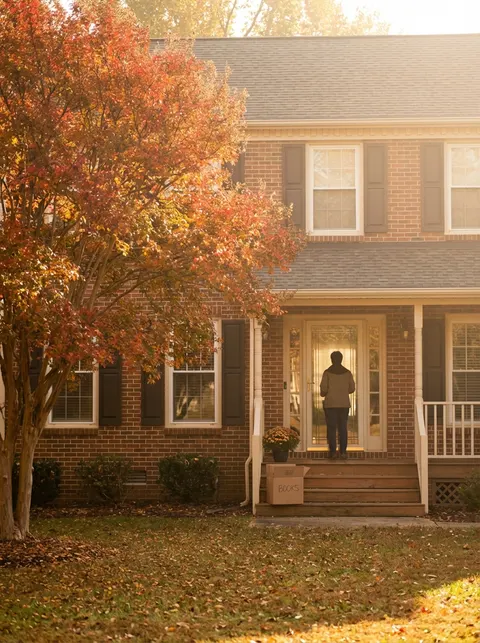
The house is usually the biggest fight. Not the retirement accounts. Not the cars. The house. Because it's not just money — it's where the kids grew up, where the garden is, where one of you wants to stay and the other one wants to get paid. And in North Carolina, figuring out who keeps it (or whether anyone does) gets complicated fast.
I've bought houses in Raleigh, Charlotte, and Greensboro from couples going through divorce. Sometimes both spouses called me separately before they'd even spoken to each other about selling. The emotions are raw. The financial pressure is real. And the legal framework in NC adds layers that most people don't understand until they're knee-deep in it.
Here's what you actually need to know about the house during a North Carolina divorce — whether you're buying out your spouse or selling the whole thing.
How NC Law Treats the House in Divorce
North Carolina is an "equitable distribution" state. That doesn't mean 50/50. It means the court divides marital property in a way it considers fair — which may or may not be equal, depending on a dozen factors including income, earning potential, length of the marriage, and who contributed what.
The house is marital property if it was acquired during the marriage, regardless of whose name is on the deed or mortgage. Even if only one spouse's name is on everything, if it was bought between the wedding date and the date of separation, it's marital property. Both spouses have a claim.
There are three typical outcomes for the house:
- One spouse buys out the other's equity share
- The house is sold and the proceeds are divided
- One spouse keeps the house (temporarily) as part of a broader property settlement
The first two are by far the most common. Let's break them down.
The Buyout: How It Works in Practice
A buyout means one spouse keeps the house and compensates the other for their share of the equity. Sounds simple. It rarely is.
Step 1: Determine the home's current market value
Both spouses need to agree on what the house is worth right now — not what you paid for it, not what Zillow says, not what the neighbor's house sold for. You need either a formal appraisal (typically $300-500 in NC) or a broker price opinion. If you can't agree, the court will order one.
In contentious divorces, I've seen each spouse hire their own appraiser, get two different numbers, and then argue about which one is right. If the gap is $30,000 on a $350,000 house, that's $15,000 in disputed equity. This is where things stall.
Step 2: Calculate the equity
Market value minus mortgage payoff = equity. If the house is worth $350,000 and you owe $220,000, there's $130,000 in equity to divide. In a typical equitable distribution scenario, each spouse's share is $65,000 (though the actual split depends on the broader settlement).
Step 3: The buying spouse pays out the equity share
This is where most buyouts hit a wall. The buying spouse needs to come up with $65,000 — usually by refinancing the mortgage in their name alone. That means they need to qualify for a new mortgage based on their individual income, their individual credit score, and the current interest rate. In 2026, with rates where they are, a lot of spouses who could have qualified two years ago can't anymore.
If you made $85,000 combined and now you're qualifying on your $52,000 salary alone — at a 6.5% rate instead of the 3.5% you locked in during the marriage — the monthly payment might jump from $1,200 to $1,900. Can you afford that? Your lender needs to say yes.
Step 4: Remove the other spouse from the deed and mortgage
The refinance accomplishes both — the old joint mortgage gets paid off, the new individual mortgage takes its place, and a new deed is recorded showing only the buying spouse. This is critical. If you don't refinance and just keep the existing mortgage, the departing spouse is still legally on the hook. If the staying spouse stops paying, the departing spouse's credit gets destroyed too.
If you keep the house but don't refinance — maybe because you can't qualify — the departing spouse stays on the mortgage. That means their debt-to-income ratio still includes your house payment, which can prevent them from buying their own home. Courts in NC often set a deadline for refinancing (typically 6-12 months). If you miss that deadline, the court can order the house sold. Don't agree to a buyout you can't actually execute.
When Selling Makes More Sense Than a Buyout
I'll be direct. In about half the divorce situations I see, the buyout doesn't make financial sense. Here's when selling is the smarter move.
Neither spouse can qualify for a refinance alone
Combined income qualified you for the mortgage. Individual income might not — especially at today's rates. If neither of you can refi, keeping the house isn't an option. Sell it, split the proceeds, and each start fresh with a clean balance sheet.
The house needs significant work
During the marriage, you deferred maintenance. The roof needs replacing. The HVAC is 18 years old. The master bath has a leak you've been ignoring. Neither of you wants to sink $25,000 into a house during the most expensive period of your lives (divorce attorneys aren't cheap). A cash buyer takes the house as-is. No repairs. No arguments about who pays for what.
The emotional weight is too heavy
I know how this sounds coming from a guy who buys houses for a living. But I mean it. Staying in the marital home after a divorce keeps you connected to something you're trying to move past. I've watched sellers — men and women both — visibly lighten up after closing. The house was an anchor. Selling it was the start of actually moving on.
Speed matters more than maximum price
Divorce proceedings in NC can drag on. Selling the house quickly removes the biggest financial variable from the negotiation. Both spouses get liquid cash. Both can secure housing independently. The settlement gets simpler. I've had attorneys tell me a fast cash sale shortened their client's overall divorce timeline by months — because the house was no longer a contested issue.
“My ex and I couldn’t agree on anything about the house. Cinch made one offer we both accepted and closed in two weeks.” — Tamara D., Raleigh
How a Cash Sale Works During an NC Divorce
Both spouses need to agree on the sale (unless a court orders it). Once there's agreement, the process looks like this:
Day 1: You contact Cinch Home Buyers or another local cash buyer. We look at the property, pull comps, assess condition.
Day 1-2: We make a written offer. Both spouses review it — separately or together. Their attorneys review it.
Day 3-7: If accepted, a NC closing attorney opens title. Both spouses sign the purchase agreement. The title search runs.
Day 7-14: Closing. Both spouses (or their attorneys via power of attorney) sign the deed. Mortgage gets paid off from proceeds. Remaining equity is distributed per the separation agreement or court order. Funds wire to each party's account.
No showings. No staging. No open houses where you have to pretend everything's fine while strangers walk through your bedroom. No buyer financing that might fall through at week six.
The closing attorney handles the distribution according to whatever agreement or court order governs the split. If there's no agreement yet, the proceeds can be held in escrow until the equitable distribution is finalized.
| Factor | Buyout (Refinance) | Cash Sale (Sell & Split) |
|---|---|---|
| Timeline | 2 – 6 months (refi + legal) | 7 – 14 days |
| Qualification required | Solo income, solo credit score | None — cash buyer qualifies |
| Repairs needed | May need appraisal-driven repairs | $0 — sold as-is |
| Ongoing entanglement | High — departing spouse stays on mortgage until refi | None — clean break at closing |
| Best for | One spouse wants the house AND can afford it | Both want a fast, final resolution |
What Happens If You Can't Agree on Selling
If one spouse wants to sell and the other doesn't, it goes to court. In North Carolina, either spouse can petition for a court-ordered sale as part of equitable distribution proceedings. The court can:
- Order the house sold on the open market
- Set a minimum acceptable price
- Appoint a commissioner to manage the sale
- Divide the proceeds according to equitable distribution principles
Court-ordered sales take longer and cost more (court fees, commissioner fees, attorney time). They also remove your control over the process — the court decides the terms, not you. If there's any way to agree on a sale between yourselves, that's almost always better financially and emotionally.
I've worked with divorce attorneys in Wake County, Mecklenburg County, and Guilford County who recommend a cash sale specifically to avoid the court-ordered process. It gives both parties a clean, fast resolution that keeps control in their hands.
Protecting Yourself During the Process
A few things I've learned from buying houses in divorce situations:
- Get your own attorney. Even if it's amicable. Especially if it's amicable. Verbal agreements about the house dissolve when money is on the table.
- Don't stop paying the mortgage. Both names are on it. Both credit scores take the hit. Even if your spouse moved out and "agreed" to keep paying — if they don't, it's your problem too.
- Don't make improvements. That $15,000 kitchen renovation you're thinking about to "increase the value"? You're spending joint money on a joint asset during a property dispute. Your spouse's attorney will have thoughts about that.
- Don't leave the house empty. If neither spouse is living in it, the same vacant-property risks apply — insurance issues, pipe freezes, vandalism, code violations. One of you needs to maintain it until sale, or sell fast.
Divorce is hard enough without the house dragging it out. Whether you're selling during the divorce or negotiating a buyout, get the numbers right, get good legal counsel, and make decisions based on math — not emotion. The house is equity. Treat it like equity, and you'll come out of this in better shape.
If you need a fast, clean number to work with, get a cash offer from Cinch. It takes 24 hours, costs nothing, and gives both attorneys a real number to negotiate from. That's usually what gets things moving.
Frequently Asked Questions
One spouse pays the other their share of the home’s equity, typically by refinancing the mortgage in their name alone. The refinance pays off the joint mortgage, and a new deed is recorded with only the buying spouse’s name. The departing spouse receives their equity share from the refinance proceeds. Both spouses must agree on the home’s current market value to calculate the equity split.
Yes. If spouses cannot agree on what to do with the marital home, either party can petition the court as part of equitable distribution proceedings. The court can order the property sold, appoint a commissioner to manage the sale, and divide the proceeds. Court-ordered sales take longer and cost more than voluntary sales.
You have two options: negotiate through attorneys to reach a settlement, or petition the court for an order of sale as part of equitable distribution. A mediator can sometimes help break the impasse. Having a concrete cash offer on the table — showing both parties exactly what they’d receive — often moves negotiations forward faster than hypothetical market estimates.
NC uses equitable distribution, which means fair but not necessarily equal. The court considers factors like each spouse’s income, contributions to the property, length of marriage, and other marital assets. In practice, a 50/50 split of home equity is common, but the court has discretion to adjust based on circumstances.
Yes, if both spouses agree. You don’t need a finalized divorce decree to sell marital property — you need both parties’ signatures on the deed. The sale proceeds can be divided per a separation agreement or held in escrow pending the final equitable distribution order. A cash sale can close in 7–14 days, often before divorce proceedings are complete.
We close divorce-related sales in 7–14 days once both spouses agree to sell. Both parties (or their attorneys via power of attorney) sign the documents. The closing attorney distributes proceeds per the separation agreement or court order. No repairs, no showings, no commissions.