
Selling your house without a Realtor in North Carolina is legal, and the math changed in your favor more than most FSBO sellers realize. I've bought more than 200 homes across this state, and I've watched plenty of people try the for-sale-by-owner route. Some saved real money. Others priced wrong, lost two months, and called me anyway. The difference is almost never grit. It's knowing the three NC-specific things that quietly decide whether a FSBO sale works.
Most "how to sell without an agent" articles you'll find are recycled and out of date. They tell you to budget 2-3% for the buyer's agent, that you "must disclose every defect," and not much that's specific to this state. In 2026, parts of that are flat wrong. Below I'll walk the real NC process in order, then spend the back half on what actually trips sellers up here: how the August 2024 commission rules rewrote the buyer-agent question, the disclosure loophole NC law actually gives you (and where it bites if you abuse it), and the second mandatory form almost nobody mentions.
Step 1: Price Your Home Accurately
Pricing is where most FSBO sellers lose money before they even start. Without daily access to MLS sold data, it's tempting to lean on Zillow's Zestimate or a tax value from your county. Both can be wildly off. I've seen Zestimates miss by $40,000 on homes in Wake County, and tax values in Mecklenburg and Durham counties are sometimes two years behind the actual market.
How to research comps yourself
- Check Zillow, Redfin, and Realtor.com for sold prices (not list prices) within half a mile of your home, filtered to the last 90 days
- Match by bed/bath count, square footage within 15%, and similar lot size
- Adjust for condition honestly -- a fully renovated kitchen in a Five Points bungalow adds value; a 20-year-old HVAC system in a Garner ranch reduces it
- Pay a licensed appraiser $400-$600 for a professional opinion before listing -- this is the best insurance policy against pricing wrong
NC county tax records are public and accessible through your county's GIS portal (Wake uses iMAPS, Mecklenburg has Polaris 3G, Durham has their own GIS system). These confirm square footage, lot dimensions, and ownership history, but they will not show you what a neighbor's house actually sold for. For that, you need the Register of Deeds records -- public, but slower to dig through. Or you can use a cash offer calculator to get a quick baseline on your home's value without the legwork.
Overpricing is the single most costly FSBO mistake. A home that sits on the market 60+ days in the Triangle or Charlotte develops stigma fast. Buyers and their agents start wondering what's wrong with it. Price it right from day one -- you will not get a second chance to make a first impression.
Step 2: The NC Disclosure Rules (and the Loophole Most People Get Wrong)
Here's where almost every FSBO article steers you wrong, so read this twice. North Carolina law (G.S. 47E) requires most residential sellers to hand the buyer a Residential Property and Owners' Association Disclosure Statement before the buyer makes a written offer. But North Carolina is a "buyer beware" state. The form's roughly three dozen questions let you answer "Yes," "No," or "No Representation." That third option is the part people miss: you can legally decline to make any statement about a condition, and for things you actually didn't know about, "No Representation" generally lifts your duty to disclose. You are not, despite what most articles claim, forced to write down every flaw in your house.
That said, the loophole has a hard edge, and I've watched sellers walk right into it:
- "No Representation" is not a license to lie. It protects you on things you didn't know. It does nothing for a defect you knew about and actively hid or misrepresented. Conceal the known basement leak and check "No Representation," and you've handed the buyer's attorney a fraud claim, not a defense.
- The form has to reach the buyer at or before the written offer. Deliver it late and the buyer gets a window to cancel, even if you're already under contract.
- Selling "as-is" doesn't change any of this. As-is means you won't repair; it has nothing to do with what you do or don't represent on the form.
- Exemptions exist (foreclosure, court-ordered sales, certain transfers), but a normal homeowner-to-buyer sale needs the full form.
The second form nobody mentions: NC also requires a separate Mineral and Oil and Gas Rights Mandatory Disclosure Statement (G.S. 47E-4.1) on most residential sales. It's short, it carries the Real Estate Commission seal, and skipping it gives the buyer the same cancellation rights as a missing property disclosure. If your home predates 1978, add the federal lead-based paint disclosure on top. Both the property disclosure and the mineral-rights form are free downloads from the NC Real Estate Commission's site.
My honest take after 200-plus closings: think hard before reflexively choosing "No Representation" on a house you've lived in for fifteen years. A buyer who sees "No Representation" down the whole form reads it as "what is this seller hiding," and it can cost you in price or kill the deal during due diligence. The protection is real, but so is the signal it sends.
Step 3: Contracts and Paperwork
The North Carolina Association of Realtors (NCAR) publishes the standard real estate contracts used in virtually every residential transaction in this state. As a FSBO seller, you can access these forms through a real estate attorney or a flat-fee listing service. The three documents you absolutely need:
- Offer to Purchase and Contract (Form 2-T): This is the primary purchase agreement. It covers purchase price, due diligence period, closing date, earnest money, and every material term of the deal.
- Due Diligence Request and Agreement: NC's due diligence model is unique. The buyer pays a non-refundable due diligence fee upfront for the right to inspect the property, get financing, and back out for any reason during the due diligence window.
- Earnest Money Deposit: Held by the closing attorney or a licensed escrow agent. Do not hold this money yourself -- as an unlicensed seller, that creates legal exposure you do not want.
The due diligence model trips up FSBO sellers who've bought or sold in other states. Short version: the buyer negotiates a due diligence period (often 14-30 days here) and pays a due diligence fee, anywhere from a few hundred dollars to several thousand depending on price point and how hot the local market is. During that window the buyer can walk for any reason and forfeits only the DD fee; the earnest money still comes back. Once the deadline passes, the earnest money is at risk too, so if they bail without cause after that, you keep it.
Two things matter for you as the seller. First, the structure is your leverage: a low DD fee with a long DD window is bad news, because it buys the buyer weeks to keep shopping with almost nothing on the line. Push for a real fee or a shorter window. Second, "non-refundable" has one common exception worth knowing. If the buyer is using FHA or VA financing and the home appraises low, the FHA/VA financing addendum can force you to refund that due diligence fee unless you two agree on a price. So that signed DD fee isn't always money in the bank the moment the deal cracks. Your closing attorney can flag whether an offer carries that addendum before you sign.
Step 4: NC Requires a Closing Attorney
North Carolina is an attorney-close state. That means a licensed attorney -- not a title company -- must conduct your closing, prepare the deed, run the title search, and handle funds disbursement. There is no way around this. You cannot close a real estate transaction in NC without a lawyer at the table.
Attorney fees for a standard residential closing in NC typically run $600-$1,200. In the Triangle (Raleigh, Durham, Chapel Hill), you'll find plenty of firms that handle high volumes of residential closings. In smaller markets like Sanford, Lumberton, or Kinston, your options may be more limited, so start looking early. The closing attorney will:
- Run a title search to confirm you have clear, transferable ownership
- Prepare the deed (usually a general warranty deed in NC)
- Create the closing disclosure that itemizes every cost for both parties
- Pay off your existing mortgage from the sale proceeds
- Collect and remit the NC excise tax (also called the revenue stamp) -- $1 for every $500 of the sale price, paid by the seller in NC. On a $300,000 home, that's $600
- Disburse your net proceeds after all liens, fees, and taxes are satisfied
- Record the new deed with the county Register of Deeds
My advice: hire the attorney before you go under contract. A good closing attorney can review offers you receive and catch contract terms that could hurt you. Think of them as your legal safety net in the absence of an agent. If you're selling anywhere in North Carolina, having an attorney involved early is one of the smartest moves a FSBO seller can make.
Want to Skip the FSBO Hassle?
Cinch Home Buyers makes cash offers on NC homes in 24 hours. No repairs, no showings, no commissions. You pick the closing date.
Get Your Free Cash OfferStep 5: Marketing Without an Agent
The biggest disadvantage of selling FSBO is losing MLS exposure. The overwhelming majority of buyers work with agents, and agents search the MLS first -- not Zillow, not Craigslist. If your home is not on the Triangle MLS (for the Raleigh-Durham area), Canopy MLS (Charlotte region), or Triad MLS (Greensboro, Winston-Salem), you're invisible to most serious buyers in those markets.
Here's how to market your NC FSBO listing effectively:
- Flat-fee MLS listing: NC-based flat-fee brokers and services like Houzeo will list your home on the local MLS for $300-$500. This is the single most important marketing decision you'll make. Do this first.
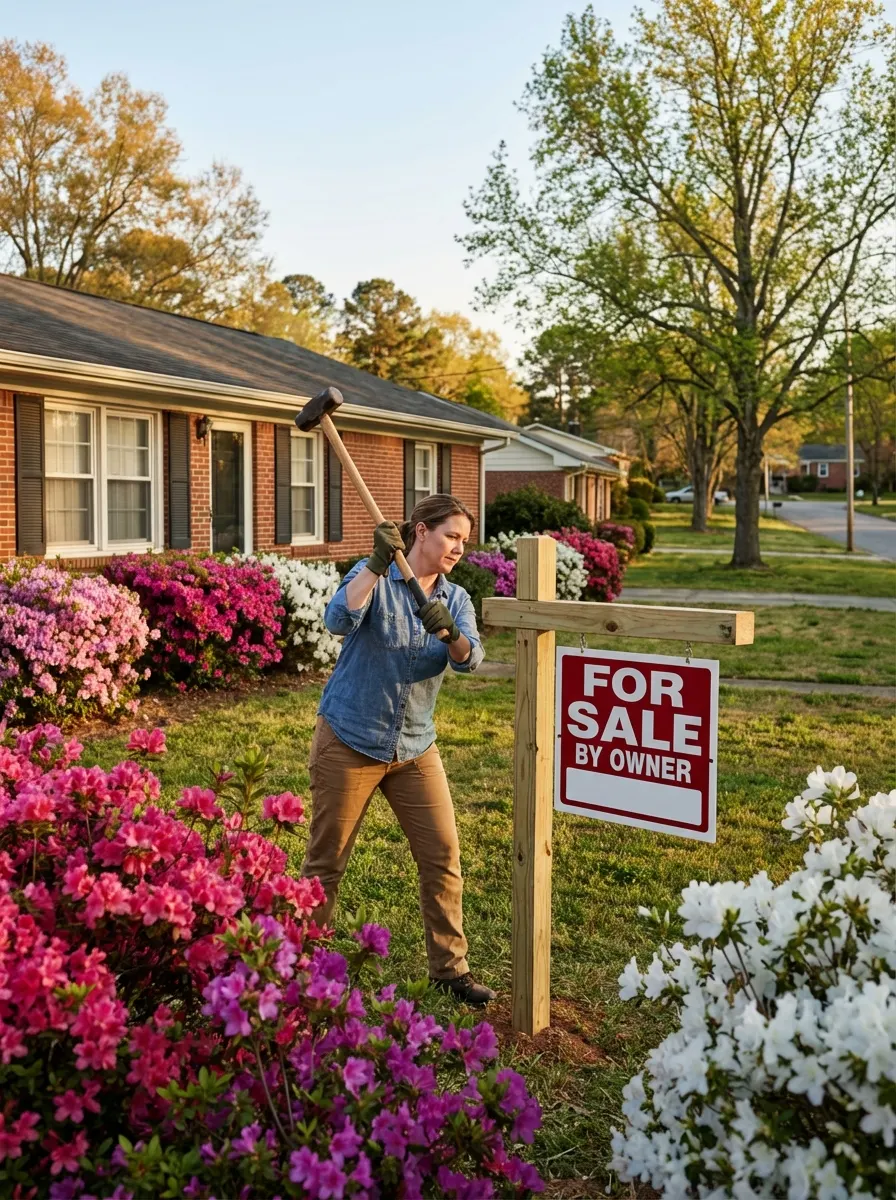
- Yard sign: Still drives calls. Especially effective in established neighborhoods like North Hills in Raleigh, Dilworth in Charlotte, or Hope Valley in Durham where foot and drive-by traffic is high.
- Facebook Marketplace: Free and surprisingly effective for homes under $350K in NC. You'll get a mix of buyers and investors.
- Zillow FSBO listing: Free to post, but Zillow ranks MLS-sourced listings higher. It's a supplement, not a strategy.
- Professional photography: Budget $200-$350 for a real photographer. Phone photos on a $300,000 listing tell buyers you're not serious. If your home is $400K+, add drone shots ($100-$150 extra).
You also need to be available to answer calls and schedule showings -- often on short notice. Agents will call to arrange buyer tours. If you don't pick up or you're slow to respond, they move on. I've heard from FSBO sellers in Raleigh and Charlotte who said the time commitment of managing showings alone was harder than they expected, especially while still working full-time.
Step 6: Closing Costs You'll Pay as a NC FSBO Seller
Going FSBO doesn't mean you avoid closing costs. You skip the listing agent's commission, but you still owe:
| Cost | Typical Amount |
|---|---|
| Closing attorney fees | $600 - $1,200 |
| NC excise tax (revenue stamps) | $1 per $500 of sale price |
| Buyer's agent commission (if applicable) | 2% - 3% of sale price |
| Title insurance (owner's policy for buyer) | $500 - $1,200 |
| Recording fees | $26 - $64 |
| Prorated property taxes | Varies by county |
| HOA transfer fees (if applicable) | $100 - $500 |
The buyer's agent commission is the line item that changed most, and it's the single biggest reason the old FSBO advice is stale. Before August 2024, the buyer's agent commission was baked into the MLS listing, and sellers were effectively expected to pay 2-3% whether they wanted to or not. After the NAR settlement took effect on August 17, 2024, that compensation can no longer be advertised on the MLS at all. It's now negotiated deal by deal, written into the offer as a concession, and buyers sign their own agency agreements spelling out what their agent gets paid.
For a FSBO seller, that's leverage you didn't used to have. You can offer nothing and let buyers cover their own agent. You can offer a flat dollar concession instead of a percentage. Or you can offer market-rate compensation if you want to keep showings flowing in a slow stretch. In a hot Triangle or Charlotte neighborhood with low inventory, plenty of sellers now pay little to no buyer-agent commission. In a soft market, offering a concession still widens your pool. The point is it's a choice now, not a tax. Run your "savings" math on what you'll actually offer, not the reflexive 3%.
When FSBO Makes Sense -- and When It Doesn't
The clearest win for FSBO is when you already have a buyer at the table: a family member, a neighbor, the renter who's been in the house for years. There's no marketing to do, so you keep the full listing commission, $7,500 to $9,000 on a $300,000 home, and you only need a closing attorney to paper it correctly. If that's your situation, do not pay an agent to introduce two people who already know each other.
Where I watch FSBO fall apart is the open-market sale under time pressure. A Durham owner with a relocation date, a house that needs real work, or a property in a slower stretch of the Triad or eastern NC is signing up for showings, counteroffers, and inspection haggling on nights and weekends. When it drags, the "savings" quietly evaporate into a lower final price and another two or three mortgage payments, and that's before a financed deal collapses in due diligence.
If that's closer to your reality, get one number before you commit: a direct cash offer to compare against. Cinch Home Buyers buys as-is across North Carolina, we cover the closing attorney, and there's no commission on either side. A cash offer comes in under full retail, and I'll never pretend otherwise. The honest comparison isn't offer-versus-Zestimate; it's our number against your realistic FSBO net: final price, minus any concession you make to a buyer's agent, minus carrying costs, minus the weeks of your life it eats. On an inherited house, a divorce sale, or anything needing major repairs, that net comparison often lands in cash's favor. It costs nothing to find out. Call (919) 751-6768 or request your offer here.
| Factor | FSBO (Sell It Yourself) | Cash Sale to Cinch |
|---|---|---|
| Listing agent commission | $0 (you save this) | $0 |
| Buyer's agent commission | Negotiable since Aug 2024 (often $0-3%) | $0 |
| Pre-listing repairs | $5,000-$25,000+ recommended | $0 -- sold as-is |
| Time investment | 10-20+ hours/week managing showings, calls, paperwork | One phone call, one visit |
| Average time to close | 3-6 months | 7-21 days |
| Risk of deal falling through | 15-20% of financed offers fail | No financing contingency |
Frequently Asked Questions
Yes. North Carolina does not require you to use a real estate agent to sell your home. However, NC does require a licensed closing attorney to handle the closing, title search, deed preparation, and funds disbursement. You cannot close a real estate transaction in NC without an attorney.
Yes, you have to deliver the form, but NC is a "buyer beware" state, so it works differently than people assume. NC law (G.S. 47E) requires the Residential Property and Owners' Association Disclosure Statement before the buyer's written offer, and you must also provide the separate Mineral and Oil and Gas Rights Disclosure (G.S. 47E-4.1). On the property form you can answer "No Representation" rather than detail every condition. That lifts your duty to disclose things you genuinely didn't know about, but it never protects you if you hide or lie about a known defect.
You save the listing agent's commission, typically 2.5-3%, which is $7,500-$9,000 on a $300,000 home. Since the August 2024 commission rules, paying a buyer's agent is now negotiable instead of automatic, so your savings can be larger than the old advice suggests. Just weigh that against the real risks of going it alone: mispricing, longer time on market, and extra months of carrying costs.
You need the NCAR Offer to Purchase and Contract (Form 2-T), a Due Diligence Request and Agreement, and an Earnest Money Deposit held by your closing attorney or licensed escrow agent. Never hold earnest money yourself -- as an unlicensed seller, that creates legal exposure.
A cash buyer makes sense when you need to sell fast (relocation, divorce, pre-foreclosure), when the home needs significant repairs, when you don't have bandwidth for showings and negotiations, or when the home has been sitting on the market without offers. Compare the cash offer to your realistic FSBO net proceeds -- not the asking price.
We Buy Houses Across North Carolina
I'm Ryan Smith, founder of Cinch Home Buyers, and I'm not a licensed agent, I'm the buyer on the other side of the table. I've purchased more than 200 homes across this state, so the disclosure forms, the due diligence clock, and the attorney-close process aren't theory to me. We're based in Cary, not a national call center, and we coordinate directly with local closing attorneys in every county we buy in. We also run a community fund that gives back to NC charities, because this is our home too. See the pages below for market-specific details:
- Sell My House Fast in Raleigh, NC
- Sell My House Fast in Durham, NC
- Sell My House Fast in Charlotte, NC
- Sell My House Fast in Cary, NC
- Sell My House Fast in Apex, NC
- Sell My House Fast in Garner, NC
- Sell My House Fast in Holly Springs, NC
More from the Cinch Home Buyers Blog: guides on selling fast, avoiding foreclosure, handling inherited properties, and understanding the NC real estate market.