
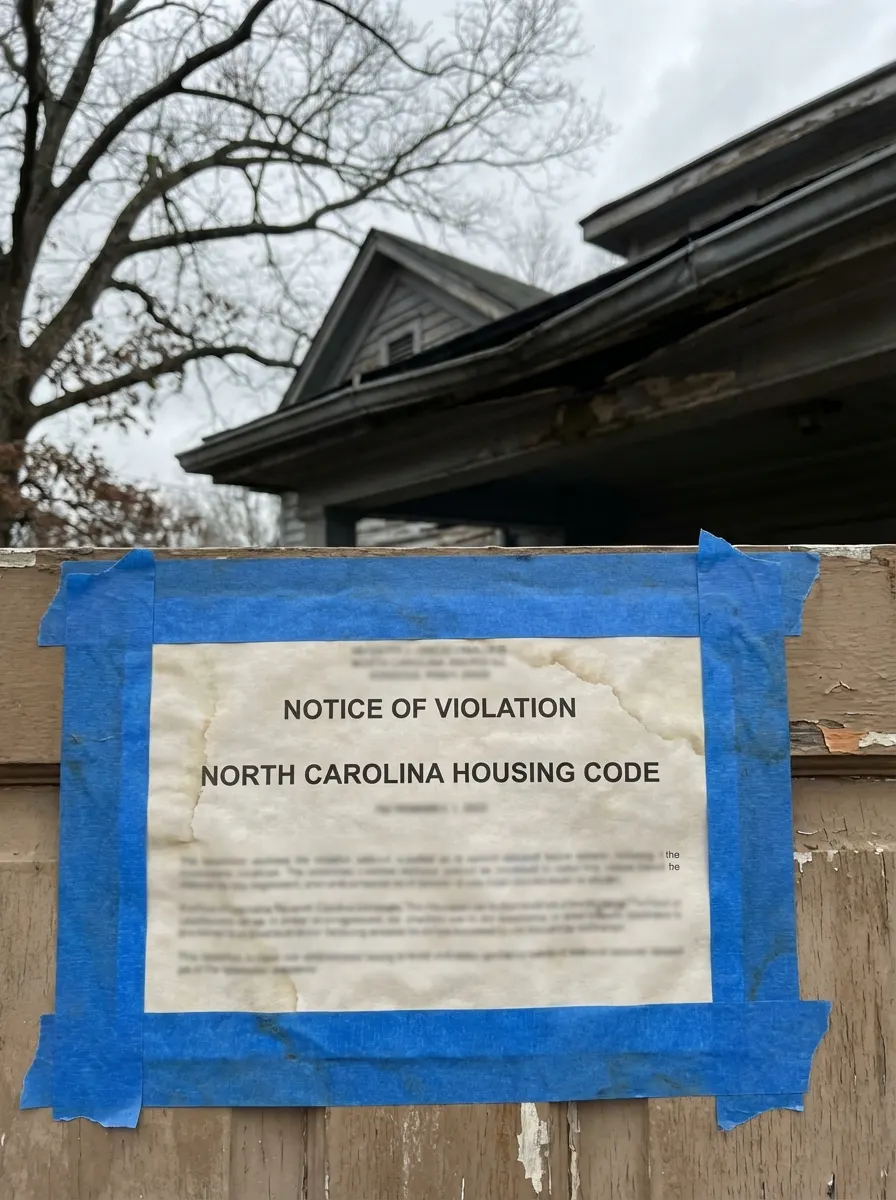
A house tied to drug activity sells differently than any other distressed property in North Carolina, and the reason isn't really the damage. It's the paper trail. A former meth lab carries a legal decontamination requirement. A grow house comes with permit-less wiring and mold that an appraiser will flag. A drug-use rental that got trashed reads as "stigmatized" to retail buyers even after it's cleaned up. Each of these scares off the exact buyers who need a mortgage, which is most of them.
That's the part sellers get wrong. They assume a meth house can't be sold until it's been cleaned, certified, and signed off. In NC, that isn't true. You can transfer ownership of a contaminated property before anyone touches it. What the law restricts is who can live there, not who can hold the deed. I'll walk through exactly how that works below, because it's the difference between being stuck and getting a check.
I've bought drug-affected houses across North Carolina, from Fayetteville rentals near Fort Bragg to grow-house cleanups in the Triad. I know what these properties cost to remediate, what NC actually requires, and how to close one without you spending a dollar on cleanup first. If you inherited one, evicted a tenant who turned the place into a lab, or just want it gone, here's the real situation and your real options.
Why a Mortgage Buyer Almost Never Closes on a Drug House
The MLS is built for houses that can get a loan, and a drug-affected property usually can't. When a buyer's lender orders an appraisal, the appraiser isn't only setting a value. They're checking whether the home is safe, sound, and secure enough for the loan program to allow it.
FHA appraisers work off HUD Handbook 4000.1. Exposed or modified wiring, water damage, mold, missing fixtures, holes cut through floors and ceilings for grow-room ventilation — these are the exact conditions a meth lab or grow operation leaves behind, and they're the conditions that kill an FHA loan. VA appraisers apply similar standards, and even conventional Fannie Mae financing has minimum property requirements a damaged drug property won't clear. With a former meth lab there's a second wall: NC law bars reoccupancy until the place is decontaminated and documented, so a lender funding a house a family is about to move into has an obvious problem.
Then there's stigma, which is its own tax. Even after remediation, the words "former meth lab" or "grow house" make many buyers walk and make some lenders cautious. Appraisers in other states have pegged the leftover discount on a remediated, fully disclosed problem house in the low single digits — small on paper, but enough to spook a nervous buyer mid-deal. So the realistic pool shrinks to cash buyers who price the history in and close anyway.
None of this means you can't sell. It means a listing on the open market is the slow, uncertain path, and cash is the direct one.
Get a Cash Offer on Your Property
Former meth lab, grow house, or a rental a tenant destroyed? We buy NC drug-affected properties as-is and handle the decontamination ourselves. No cleanup, no judgment, cash offer within 24 hours.
Former Meth Labs: What NC Law Actually Requires
North Carolina put a specific law on the books for properties where methamphetamine was manufactured: N.C. Gen. Stat. 130A-284. Since April 2005, a property someone knows was used to make meth cannot be reoccupied until it has been decontaminated. The rules live in 10A NCAC 41D .0101 through .0105, and they put the work on the "responsible party" — which can be the owner, a tenant, or whoever was in control of the place.
Here is what that responsible party has to do: assess the contamination, clean it to the point that the property is reasonably safe to live in again, keep records of the whole process, and turn that documentation over to the local health department, which reviews it and holds it on file (records are retained for about three years). Until that happens, nobody is allowed to move back in.
One detail trips a lot of sellers up, and it matters: North Carolina does not set a numeric residue limit and does not require lab testing. There's no federal "safe level" of meth residue either. Instead of mandating swab tests against a threshold, NC takes a practical approach built around removing and disposing of contaminated materials and cleaning the structure. So if a contractor or a competitor tells you the state requires you to hit "0.1 micrograms per 100 square centimeters" or pass an air test before you can do anything, that's not how the NC rule is written. Cleanup is what's required; a specific test number is not.
Now the part that gets you unstuck: the decontamination requirement restricts reoccupancy, not the transfer of ownership. You can sell and deed a contaminated property to a buyer before a single thing is cleaned. The obligation to decontaminate before anyone lives there travels with the property to the new owner. That's exactly why a cash buyer like us can take it as-is — we fold the decontamination into our renovation budget and handle the health-department paperwork ourselves. You don't assess it, you don't clean it, you don't certify it. I've bought former meth properties in Fayetteville and Greensboro, and in every case the seller walked away without lifting a finger on cleanup.
What does that cleanup cost, for context? Industry estimates put meth decontamination anywhere from a few thousand dollars to well over a hundred thousand, with a typical job landing around $15,000 to $20,000, depending on how deep the chemicals soaked into drywall, HVAC, and subfloor. That number is the buyer's problem, not yours — but it's the single biggest reason the offer on a meth house is lower than on a comparable clean house. It's not a lowball; it's the remediation bill coming out somewhere.
Grow Houses and Drug-Use Rentals: Different Damage, Same Exit
A marijuana grow operation wrecks a house in its own way. Constant humidity from the plants breeds mold inside walls and ceilings. The electrical gets re-rigged off the books to feed lights and fans, often bypassing the panel entirely — a fire risk and an automatic appraisal flag. Holes get cut through floors, ceilings, and ductwork for airflow. There's no meth-style decontamination statute hanging over a grow house, so the stigma is lower, but the physical repair bill can be just as ugly, and lenders still balk at the unpermitted wiring and the mold.
A rental that was used for drug sales or drug use, without any manufacturing, is usually the most straightforward of the three. There's no special legal cleanup standard, and what's left behind is typically damage and filth, not chemical contamination. That's standard renovation work — turnover cleaning, fresh surfaces, sometimes new flooring. The hard part is rarely the repair; it's that a landlord who just went through this doesn't want to sink another $20,000 and three months into a house they're done with. Selling as-is ends it in one move.
The damage that usually rides along
Drug houses rarely come with just the drugs. The same neglect that let a lab or grow op take over a place tends to bring company, and any of it can sink a mortgage on its own:
- Hoarding-level clutter. Tenants who used a house this way often left it packed. The weight stresses floor joists, blocked vents trap moisture, and you can't even tell what's under it all until the contents come out, which alone can run several thousand dollars before a single repair. We clear it; you don't.
- Mold and water intrusion. Grow-house humidity and long-deferred maintenance both feed mold, and in older NC homes with crawl spaces it spreads into subfloor and wall cavities. Remediation can cost more than the rest of the renovation combined.
- Code enforcement on your back. If a county inspector has already flagged the property, every week of delay adds risk under NC's minimum housing rules, and demolition liens can outrun the home's value. We can close fast enough to get ahead of that and deal with the county ourselves.
If the situation has gone past damage into a formal order, two related reads cover it: selling a condemned house in NC and selling a house in foreclosure. Short of condemnation, a drug-affected house almost always sells faster than owners expect.
NC's disclosure form (the RPOADS) lets you answer "no representation" to most questions, but anything you do answer has to be truthful. A property's prior use as a meth lab counts as a material fact, and a licensed agent has a duty to disclose material facts they know of. The flip side: once decontamination is completed and documented with the health department, no meth disclosure is required. When you sell to us, you disclose what you know, we accept the history, and we move forward. Nothing hidden, nothing fixed first.
How Cash Buyers Actually Price These Properties
I want to be direct about this because a lot of sellers go into cash buyer conversations expecting market value and come out confused and frustrated. That's not fair to anyone.
Here's the math that determines what we can pay:
After-repair value (ARV) — what the property would sell for on the open market after full renovation, based on comparable sales in that specific neighborhood. A house on a specific street in Northgate in Durham has a ceiling. So does a house in a rural Nash County subdivision. The ARV is what limits everything else.
Renovation cost — not a guess, an actual estimate, and on a drug house it includes the remediation line items most sellers forget to count. That's a detailed walkthrough with contractors plus judgment built from buying 250+ NC properties. Labor in the Triangle runs higher than in Fayetteville, and material costs have stayed elevated since 2021.
Carrying costs — property taxes, insurance, utilities, loan interest (if we're using private money), and time. A 6-month renovation has 6 months of carrying costs. Those add up.
Profit margin — we're a business. We need a margin that makes the deal worthwhile. We're honest about that. Anyone who pretends they don't need a profit margin is lying.
The offer is ARV minus renovation minus carrying costs minus margin. On a drug house, "renovation" includes the part that's specific to your situation: meth decontamination, mold remediation, or tearing out and replacing the wiring a grow op hacked together. Those line items are real money, and they come out of the offer because they have to come out of someone's pocket. For a house in a neighborhood where the after-repair value is around $180,000 that needs $60,000 of total work including remediation, the math lands somewhere in the $90,000s to low $100,000s depending on specifics. It's not what a finished house sells for, because there's no finished house yet. There's a contaminated one that has to be cleaned, repaired, and certified first.
What you get in return: no repairs, no agent commissions (typically 5-6% in NC), no closing costs, no holding costs while the house sits on market, and certainty. A cash deal that closes doesn't fall through because an appraiser had a problem with the roof or a lender declined the loan two weeks before closing.
Who Ends Up Selling a Drug House — and Why
Almost nobody who calls me about a drug-affected property caused the problem. They inherited it, rented to the wrong person, or got blindsided. The circumstances are real, and they're more common than you'd think.
Landlords after an eviction. This is the one I see most. A tenant turns a rental into a grow house or a lab, or just runs it into the ground using drugs there, and the owner only learns the full story once they get the keys back. Around the military community in Fayetteville and the college rentals near NC State or East Carolina, this happens to otherwise careful landlords. They don't want to be landlords anymore, and they don't want to pour another $40,000 into a place that already burned them.
Families who inherited it. A relative dies, the estate opens, and the heirs discover the house was tied up in drug activity, sometimes for years. They live in Charlotte or Raleigh, they can't manage a remediation from a distance, and a contaminated house won't sell on the MLS. A cash sale closes the estate and ends the headache.
Owners getting ahead of code enforcement or a lender. If a county has flagged the property, or foreclosure is bearing down at the same time, waiting six months for a buyer who probably can't get financed isn't an option. Closing fast protects whatever equity is left.
What the Process Actually Looks Like
It's three steps, and none of them require you to fix anything first.
Step one: Tell us about the property. Call us at (919) 751-6768 or fill out the form below. Give us the address and a basic description of what's going on. There's no judgment, no pressure, and no obligation. The more honest you are about the condition, the better the offer we can put together.
Step two: We assess and make an offer. For most properties, we can give a preliminary number quickly based on what you tell us and what we know about the area. For heavily distressed properties, we may want to walk through the house first. Either way, we don't drag the process out. You'll have a clear cash offer within 24 hours of our assessment.
Step three: Close on your timeline. If you want to close in 7 days, we can do that. If you need 30 days to sort out the estate or find your next place, we work around your schedule. Closing happens through a North Carolina real estate attorney. You get a check. We take over the property and everything that comes with it.
Drug history doesn't have to stop the sale.
Meth lab, grow house, or a trashed rental — we buy NC drug-affected properties as-is, before any decontamination, and take the cleanup on ourselves. Cash offer in 24 hours, nothing to fix first.
Frequently Asked Questions
Can I sell a former meth house in NC before it is decontaminated?
Does NC require lab testing or a specific meth residue level?
Do I have to disclose past drug activity when selling a house in NC?
Can a regular buyer get a mortgage on a former meth lab or grow house?
How fast can you close on a drug-contaminated NC house?
Ready to put the drug house behind you?
No cleanup. No fees. No judgment. We handle the decontamination. Cash offer within 24 hours.
