

Selling a house as-is in North Carolina means one thing legally: you won't make repairs or give repair credits — the buyer takes the property in its current condition. It does not mean you can hide what you know is wrong with it, and it doesn't automatically mean a fire-sale price. With Charlotte's median sale price at $420,000 as of February 2026 (per Canopy MLS), the gap between a smart as-is sale and a bad one is real money.
I buy houses as-is across Charlotte for a living, so I'm going to show you the part of this conversation most articles dodge: exactly what buyers like me deduct from an offer and why, the honest math across all three ways to sell as-is, and the red flags that separate a real as-is buyer from a re-trader who'll cut the price after you've signed.
What "As-Is" Legally Means in North Carolina
As-is means the buyer accepts the property in its current condition, and you're stating up front that the price already reflects that condition — no repair lists, no credits at closing, no post-inspection renegotiation. That's the whole concept.
What survives an as-is sale untouched: your disclosure obligations (next section), the buyer's right to inspect (they can look — they just can't make fixing things your problem), and all the normal mechanics of an NC closing, including the attorney, the title search, and the payoff of any mortgage from proceeds. As-is is a pricing posture, not a legal escape hatch.
The Surprise: Every NC Home Sale Is Technically As-Is by Default
Here's what most Charlotte sellers don't know: the standard North Carolina Offer to Purchase and Contract is built around a due-diligence model in which the buyer accepts the property in its current condition unless repairs are negotiated in writing. The seller never has an automatic obligation to fix anything — repair requests are just that, requests, made during the buyer's due-diligence window with the threat of walking away as leverage.
So "selling as-is" in NC isn't a special contract type. It's an announcement about how you'll respond to those requests: with a no. The value of saying it up front is that it filters your buyer pool to people who price the condition before offering — instead of buyers who offer high, inspect, and then claw the price back item by item. That filtering is the entire strategy of an as-is sale done well.
What You Still Must Disclose: The REC 4.22 Form
North Carolina sellers complete the Residential Property and Owners' Association Disclosure Statement — NC Real Estate Commission form REC 4.22 — in nearly every residential sale, as-is included. The form walks through the house system by system, and for each item you can answer yes, no, or "No Representation."
"No Representation" is allowed — actively concealing a known material defect is not. If you know the crawlspace floods every spring, as-is doesn't make that knowledge disappear; it just means you won't be the one paying to fix it. Disclose honestly and price accordingly. Sellers get sued over concealment, not over condition. (Worth knowing: there's also no NC law preventing you from selling with open code violations — disclosure is required, remediation is not. We cover that in our statewide guide to selling as-is in North Carolina.)
What As-Is Buyers Deduct in Charlotte, Item by Item
When I walk a Charlotte house, I'm building a repair budget that gets subtracted from what the house would be worth fixed up. Here's the honest version of that list — what gets priced, why, and how:
| Item | Why It Moves the Number | How Buyers Price It |
|---|---|---|
| Roof | Age and leaks decide it — a roof near end-of-life fails financing and insurance for the next owner | Full replacement bid if it's at end of life; patch-level cost if it's localized |
| HVAC | Charlotte summers make a dead or dying system a day-one expense | Replacement bid by system age and size; service-record houses price better |
| Foundation / crawlspace | The scariest line item — moisture, settling, and piers carry both repair cost and resale stigma | Structural contractor estimate plus a buffer for what opens up once work starts |
| Electrical panel | Certain legacy panels in older Charlotte housing stock are insurance and safety flags | Panel replacement bid; full rewire only if knob-and-tube or aluminum shows up |
| Plumbing / sewer line | Older lines under slab or yard fail expensively; polybutylene-era pipe gets flagged on sight | Camera-scope findings drive it: spot repair vs. full line replacement |
| Kitchen & baths | Dated finishes don't break the house, but they set the after-repair resale ceiling | Cosmetic refresh vs. full remodel budget, scaled to the neighborhood's ceiling |
Two honest notes about that table. First, condition interacts: a dated kitchen in a sound house is a light deduction; the same kitchen plus a wet crawlspace plus a 20-year-old roof compounds. Second, every buyer prices these differently depending on their contractor costs and exit plan — which is exactly why the same Charlotte house can get offers tens of thousands of dollars apart, and why you should always collect more than one. The full formula buyers use is laid out in our guide to how much cash buyers actually pay in Charlotte.
The 3 Ways to Sell As-Is in Charlotte
You have three as-is exits, and each has a real trade-off:
- List as-is on the MLS. Widest exposure and the highest potential gross. The friction: financed buyers' inspections still happen, "as-is" listings draw lowball offers anyway, deals fall through when lenders balk at condition, and you ride the full timeline — 68 days on market on average and 113 days list-to-close in the Charlotte region, per Canopy MLS, February 2026.
- Sell to an iBuyer. Fast and convenient for near-market-ready homes. Per Houzeo's Charlotte analysis, iBuyers typically pay 70-80% of fair market value before service fees of 5% or more — and they generally don't want heavy repair projects at all, so true fixer-uppers get declined or repair-credited down after their assessment.
- Sell to a local cash buyer. Lowest gross, fastest certain net: offer in about a day, no repairs, no cleanout, no commission, closing in 1-3 weeks. Per the same Houzeo analysis, investor and franchise cash buyers pay 30-70% of fair market value depending on condition — a wide range, which is precisely why you compare offers. We published our honest list of the best cash home buyers in Charlotte, competitors included, to make that comparison easy.
The Worked Math: $420K Charlotte House, Three Ways
Let's run a dated-but-sound house worth Charlotte's $420,000 median (Canopy MLS, Feb 2026) if it were fixed up, needing meaningful work. All figures below are illustrative assumptions, clearly labeled, so you can swap in your own:
- Repair-then-list: Say the renovation runs $60,000 and the house then sells at $420,000. Subtract the $60,000, an assumed 5.5% in agent commissions (commissions are negotiable, but assume ~$23,000 here), seller concessions, and roughly four months of carrying costs — mortgage, taxes, insurance, utilities — while you renovate and ride the 113-day list-to-close average. Net lands in the low $300Ks, with overrun risk and no certainty on the resale price.
- List as-is on the MLS: Say condition-shopping buyers transact around $350,000. Subtract the assumed ~$19,000 commission, likely inspection-driven concessions even in an "as-is" listing, and ~four months of carrying costs to closing. Net lands around $320,000, with fall-through risk along the way.
- As-is cash sale: A cash offer prices the work up front — say $330,000 on this house. Subtract nothing: no commission, no fees, no repairs, two weeks of carrying costs instead of four months. Net is approximately the offer itself.
The point isn't that cash always wins — on those illustrative numbers, a smooth renovate-and-list can net more if nothing goes wrong. The point is that the gap is far smaller than the gross prices suggest, and it shrinks as the repair list grows, your timeline tightens, or your appetite for managing contractors disappears. Get your own three columns side by side — our Charlotte cash offer vs. MLS listing comparison walks the full framework.
Which Charlotte Houses Make the Most Sense to Sell As-Is
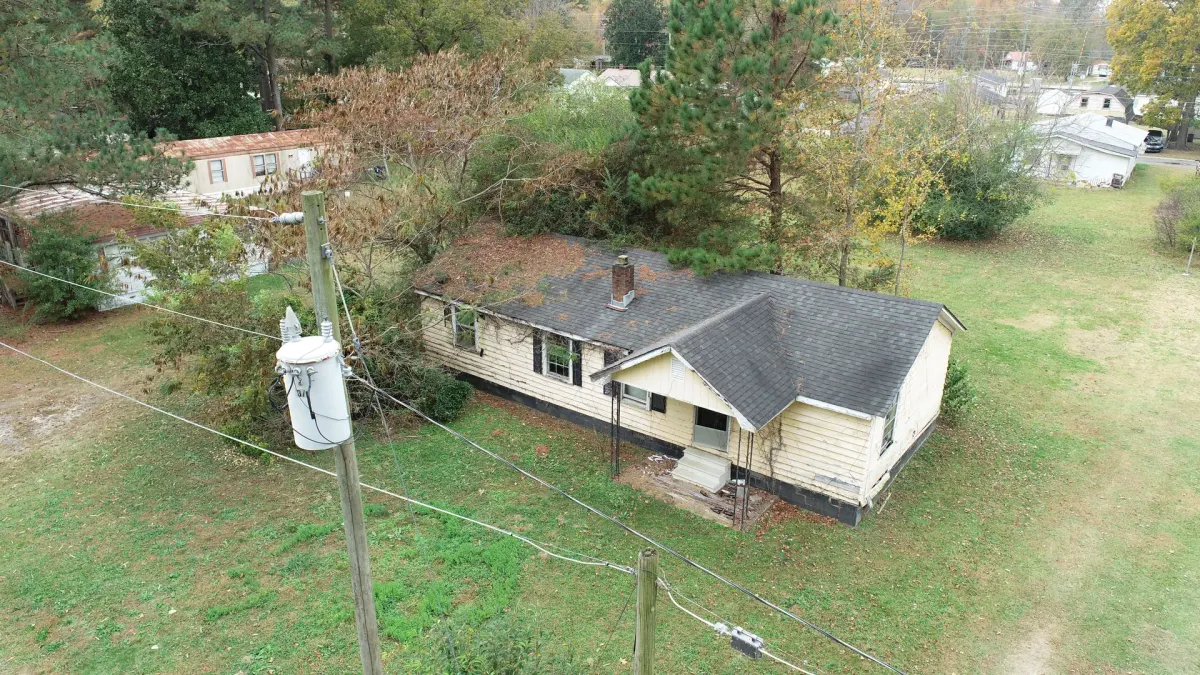
The as-is math works best on three kinds of Charlotte properties. First, older housing stock with deferred maintenance — Charlotte's mid-century and 1970s-80s neighborhoods are full of solid bones wearing original roofs, panels, and kitchens, where the repair list has simply outgrown the owner. Second, estate-condition houses — inherited homes that are dated and full of belongings, where heirs want a clean exit instead of a renovation project; our guide to selling an inherited house in Charlotte covers the probate side. Third, damaged or problem properties — fire or storm damage, failed flips, long-vacant houses. Damaged homes follow the same as-is process: disclose the damage and any insurance history, expect the repair budget to dominate the offer, and be wary of the niche "fire damage specialist" sites that are lead funnels reselling your info rather than actual buyers.
If your house is move-in ready, the calculus flips — list it. As-is selling is a tool for when condition, timeline, or life circumstances make the traditional route the expensive one.
Inspections: A Cash Walkthrough vs. the Financed-Buyer Gauntlet
A financed buyer's inspection is a renegotiation engine: a 40-page report arrives, every flagged item becomes a repair request or credit demand, the lender's appraiser adds their own condition requirements, and the deal wobbles for two weeks. In an as-is listing you can refuse the requests — but the buyer can walk during due diligence, and dated houses see it happen repeatedly before one sticks.
A cash buyer's walkthrough is the opposite: one visit, before the offer. We look at the same systems an inspector would — roof, HVAC, foundation, panel, plumbing — and the number we write afterward already includes what we saw. At Cinch there's no inspection contingency after contract and no re-trade: the offer you sign is the price at closing. That difference — priced-before-contract versus negotiated-after — is the entire psychological difference between the two processes.
Timeline: As-Is Cash vs. the Charlotte Average
The Charlotte region averaged 68 days just to go under contract and 113 days from list to close as of February 2026, per Canopy MLS — nearly four months of carrying costs, showings, and uncertainty, and that's the average, not the dated-house experience. An as-is cash sale closes in 7-21 days, set by the title search and the closing attorney rather than a lender. At Cinch you get a written offer within 24 hours and pick your closing date — 7-14 days is standard, or further out if you need time to move.
"We didn’t necessarily want to move but my Wife received a promotion at work but it required her to move to another location that was out of state... Rayan is a honest guy i would recommend him to anyone wanna sell his /her house AS-IS on the day you wanna move out." — Abe Imperial (Google review)
Red Flags: As-Is "Buyers" Who Re-Trade the Price
The ugly side of this industry is the bait-and-switch: an inflated offer to win your signature, then a "surprise" inspection finding two weeks later and a demand to cut the price — after you've stopped talking to other buyers. It works because sellers feel committed. Here's how to vet anyone, including us:
- Proof of funds. A real cash buyer shows a bank statement or fund letter on request, before contract.
- Reviews and track record. Verifiable Google reviews and actual local closings — we buy houses throughout Charlotte and Mecklenburg County (250+ NC homes bought, 4.9 on Google), and any legitimate buyer can show you the same kind of receipts.
- No inspection contingency games. Ask directly: "Can you reduce the price after we sign?" Get the answer in writing.
- An NC attorney closing. Every legitimate NC sale closes through a licensed closing attorney — anyone steering you away from that is the exit sign.
- Multiple offers. The single best defense. A re-trader's inflated number stops being tempting when you have two honest ones next to it.