
Yes — you can sell a house you inherited in Charlotte, and you usually don't have to wait for probate to finish before going under contract. A straightforward Mecklenburg County probate typically runs four to six months, and with an open estate and an appointed executor, the sale itself can often move in parallel. With Mecklenburg County's median sale price at $440,500 as of February 2026 (per Canopy MLS), the house is probably the most valuable thing in the estate — which is exactly why the process around it deserves a clear map.
This guide is that map, with the actual Charlotte logistics most articles skip: where the Estates Division is, what it costs to file, what Letters Testamentary are, and how heirs scattered across three states get a Mecklenburg County closing done without flying in.
Can You Sell an Inherited House in Charlotte? (Short Answer: Yes)
You can sell, and the timeline is friendlier than most heirs fear: a routine Mecklenburg County probate runs about four to six months, and the house can often go under contract before the estate closes. What you can't do is skip the legal sequence — someone has to be formally appointed with authority to sign for the estate before a deed can transfer.
That sequence is the whole game. Heirs who learn it in week one sell months earlier (and pay months less in taxes, insurance, and utilities) than heirs who let the house sit while the family figures out what probate even is. The sections below walk it in order: filing, appointment, authority to sell, taxes, holding costs, multiple heirs, and the renovate-or-sell-as-is decision.
The First 30 Days: Filing the Will
North Carolina requires the will to be filed with the courthouse within 30 days of death. That's not a suggestion — sitting on a will exposes you legally, and nothing else in the estate can move until it's filed. If there's no will, the estate proceeds under North Carolina's intestacy rules, and the clerk appoints an administrator instead of an executor.
Practical first-week checklist: locate the original will (not a copy), order several death certificates, and stop by or call the Estates Division to ask what their current filing process requires. Don't change the locks on a house you don't have authority over yet, and don't start giving away furniture — the estate's assets belong to the estate until someone is appointed to manage them.
Where Everything Happens: The Mecklenburg County Estates Division
North Carolina has no separate probate court — the Clerk of Superior Court serves as the probate judge, per the NC court system. For a Charlotte estate, that means one office handles essentially everything:
Mecklenburg County Clerk of Superior Court, Estates Division
832 East 4th Street, Suite 2400, Charlotte, NC 28202
(704) 686-0400
This is where the will gets filed, where you apply to be executor, where inventories and accountings get submitted, and where the estate eventually closes. If you're an out-of-state heir, note the phone number — the Estates Division can tell you what can be handled by mail or online and what requires an in-person appearance. Confirm current procedures directly with the clerk's office; courthouse logistics change.
Letters Testamentary: Your Legal Authority to Sell
Letters Testamentary are the court document appointing you executor — the proof, on paper, that you're authorized to act for the estate. Banks won't talk to you without them. Neither will a closing attorney. The estate filing fee is $120, and you apply at the Estates Division along with the will, the death certificate, and a preliminary inventory of what the estate owns.
If there's no will, the equivalent document is Letters of Administration, and the clerk follows a statutory priority list (spouse first, then children, and so on) to decide who serves. Either way, the day those Letters are issued is the day the estate — and the house sale — can actually start moving.
Can You Sell Before Probate Closes?
Often, yes — this is the question that saves estates the most time. With the estate open and the executor appointed, the house can frequently go under contract, and even close, before the estate itself wraps up. Where the buyer or title insurer needs extra comfort while the estate remains open, the deal is sometimes papered with an indemnity agreement protecting them against later estate claims.
The details depend on the will (some wills grant the executor an explicit power of sale, which simplifies everything), whether heirs join in signing, and the closing attorney's read on title. The right move is to tell buyers and the attorney up front that the property is an estate sale — an experienced Charlotte closing attorney handles probate sales routinely, and a cash buyer who works estates won't blink at the timeline. We walk through this exact dance with inherited houses all over North Carolina, and "the estate isn't closed yet" has almost never been the thing that killed a deal.
The Stepped-Up Basis: The Tax Break Most Heirs Don't Know They Have
Inherited property gets a stepped-up basis under IRS rules: your cost basis becomes the fair market value at the date of death — not what your parent or grandparent originally paid. Sell near that value, and there's little or no capital gain to tax.
A worked example (illustrative — confirm your numbers with a CPA): say your mother bought her east Charlotte house decades ago for $60,000, and it's worth $400,000 when she passes. If you sold with a $60,000 basis, you'd be staring at $340,000 of gain. But your basis steps up to $400,000 at her death — so if the estate sells the house for $400,000, the taxable gain is roughly zero. If you hold it two more years and sell for $430,000, only the $30,000 of post-death appreciation is in play.
The lesson hiding in that math: from a pure tax standpoint, selling sooner is usually cleaner. The longer you hold, the more post-death appreciation accrues — and the more holding costs you pay along the way.
What an Inherited Charlotte House Costs You Every Month
An inherited house is not free to own. Every month, somebody pays the mortgage (if one survives), property taxes, homeowner's insurance, utilities, and yard work — and if the house sits empty, standard insurance often has to be replaced with a pricier vacant-home policy. Mecklenburg County property taxes on a median-priced home are a real line item, and county-wide revaluations have pushed assessed values up across much of Charlotte.
Now stack the timeline: four to six months of probate, then — if you list traditionally — the Charlotte region averaged 68 days on market and 113 days from list to close as of February 2026, per Canopy MLS. That's most of a year of carrying costs on a house nobody lives in, before a dollar reaches the heirs. This is the single biggest reason estates choose a faster sale: not desperation, arithmetic.
Multiple Heirs: Getting Everyone to Agree
When a house passes to several heirs, every owner on title signs the deed — which means one sibling can stall the entire sale. The pattern we see in Charlotte estates over and over: two heirs want to sell, one wants to "keep it in the family" but can't buy the others out, and the house sits, bleeding holding costs, while the group argues by text message.
Three things prevent that. First, agree in writing early on price floor, decision rules, and how proceeds split. Second, give the reluctant heir a real buyout number — fair market value, their share, in writing — so the choice is concrete. Third, know the backstop: North Carolina law lets a co-owner petition for partition, which can ultimately force a sale, but it's slow, expensive, and usually radioactive for family relationships. A clean cash offer with a fixed closing date often becomes the neutral event that gets everyone to yes — it's a number on paper, not an argument.
The Out-of-State Heir Playbook
A huge share of inherited Charlotte houses belong to heirs in other states — the family scattered, and the house stayed. The good news: you can run the entire sale remotely. Documents can be signed with a mobile notary or, where the attorney allows it, by mail or power of attorney. Photos and video walkthroughs replace the showing circuit. A local cash buyer evaluates the house in one visit, and the closing attorney wires each heir's share directly.
What out-of-state heirs should not do is try to project-manage a renovation from three time zones away, or leave the house vacant for a year while the family "gets around to it." Vacant houses in any city attract problems — weather damage nobody notices, code letters nobody reads, and break-ins. If the estate's plan is to sell, the remote-friendly path is to sell as-is, soon.
Sell As-Is for Cash vs. Renovate and List: The Real Math
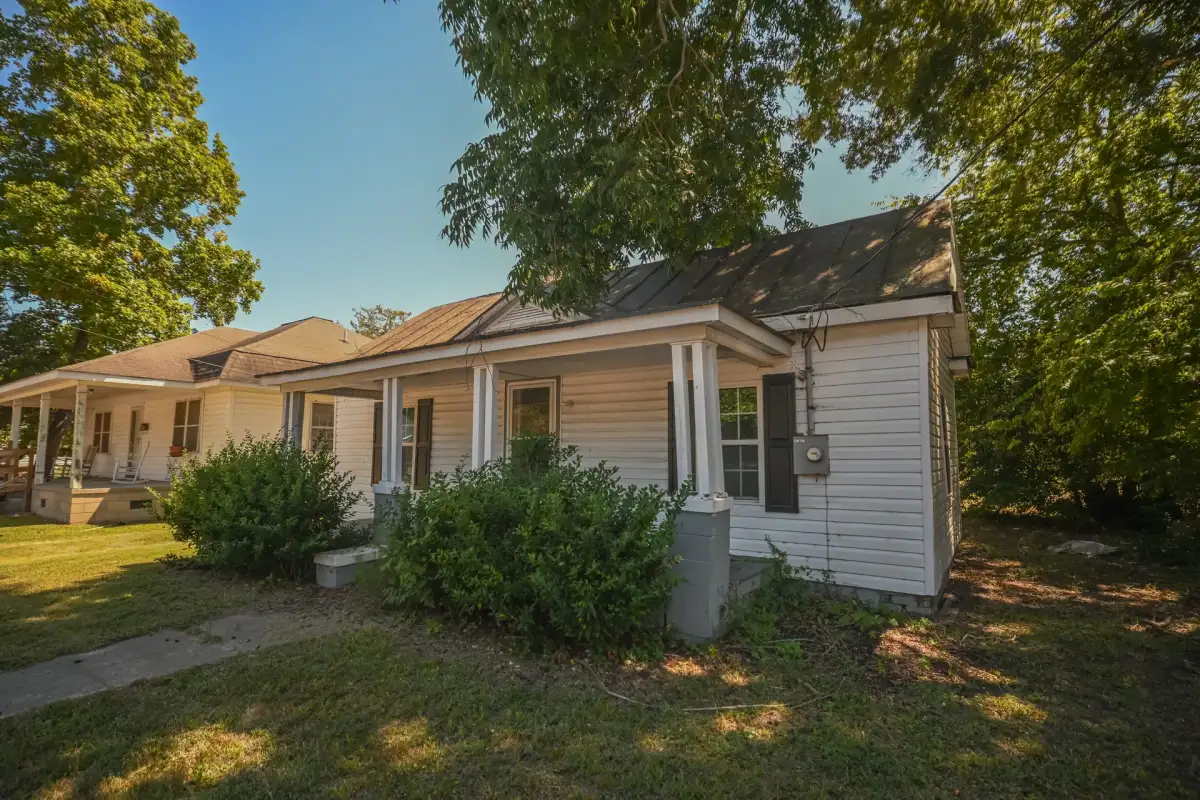
Most inherited Charlotte houses are dated — a 1970s ranch with its original kitchen, a roof in its final years, and four decades of belongings inside. You have three exits, and honest math behind each:
- Renovate and list. Highest potential gross price — and the highest risk. You front the renovation cost, manage contractors (remotely, if you're out of state), carry the house for months, then pay an agent's commission on the way out. The estate stays open longer, and every heir waits.
- List as-is on the MLS. No renovation outlay, but dated estate houses draw investor offers anyway, and financed buyers' inspections become renegotiations. You still ride the 68-day average to contract and 113 days list-to-close (Canopy MLS, Feb 2026).
- Sell as-is to a cash buyer. Lowest gross price, fastest and most certain net: no repairs, no cleanout (take the keepsakes, leave the rest), no commission, and a closing date the estate picks. We've broken down exactly how much cash buyers pay in Charlotte so you can pressure-test any offer — and our guide to selling a Charlotte house as-is shows what buyers deduct item by item.
There's no universally right answer — a renovated house in a hot Charlotte neighborhood can net more even after costs. But run all three columns with real numbers, including every month of holding costs, before assuming the biggest gross is the biggest net.
"Had a family house in Burlington. We inherited an older property, it was in rough shape. It needed major repairs we just couldn’t afford. And honestly, dealing with the estate had already stressed us out enough. That’s when Cinch Home Buyers came through as an absolute lifesaver. Ryan really walked us through everything. He bought the house completely as-is! We didn’t even have to clean it out. We took the family keepsakes and left the rest of the junk behind..." — Zack Bennett, Burlington, NC (Google review)
How Cinch Buys Inherited Houses in Charlotte
We're Charlotte cash home buyers who work estate sales regularly: 250+ homes closed across North Carolina, a 4.9 rating on Google, a written offer within 24 hours, and a closing in 7–14 days or on the date the estate picks — which matters when probate paperwork sets the schedule. No fees, no commissions, no cleanout required, and we coordinate directly with the estate's closing attorney on Letters, indemnities, and heir signatures.
And get more than one number: our comparison of the best cash home buyers in Charlotte names our competitors and tells you how to vet every one of us — proof of funds, reviews, and local closings.
Checklist: What the Closing Attorney Will Ask For
Gather these early and the closing goes fast: